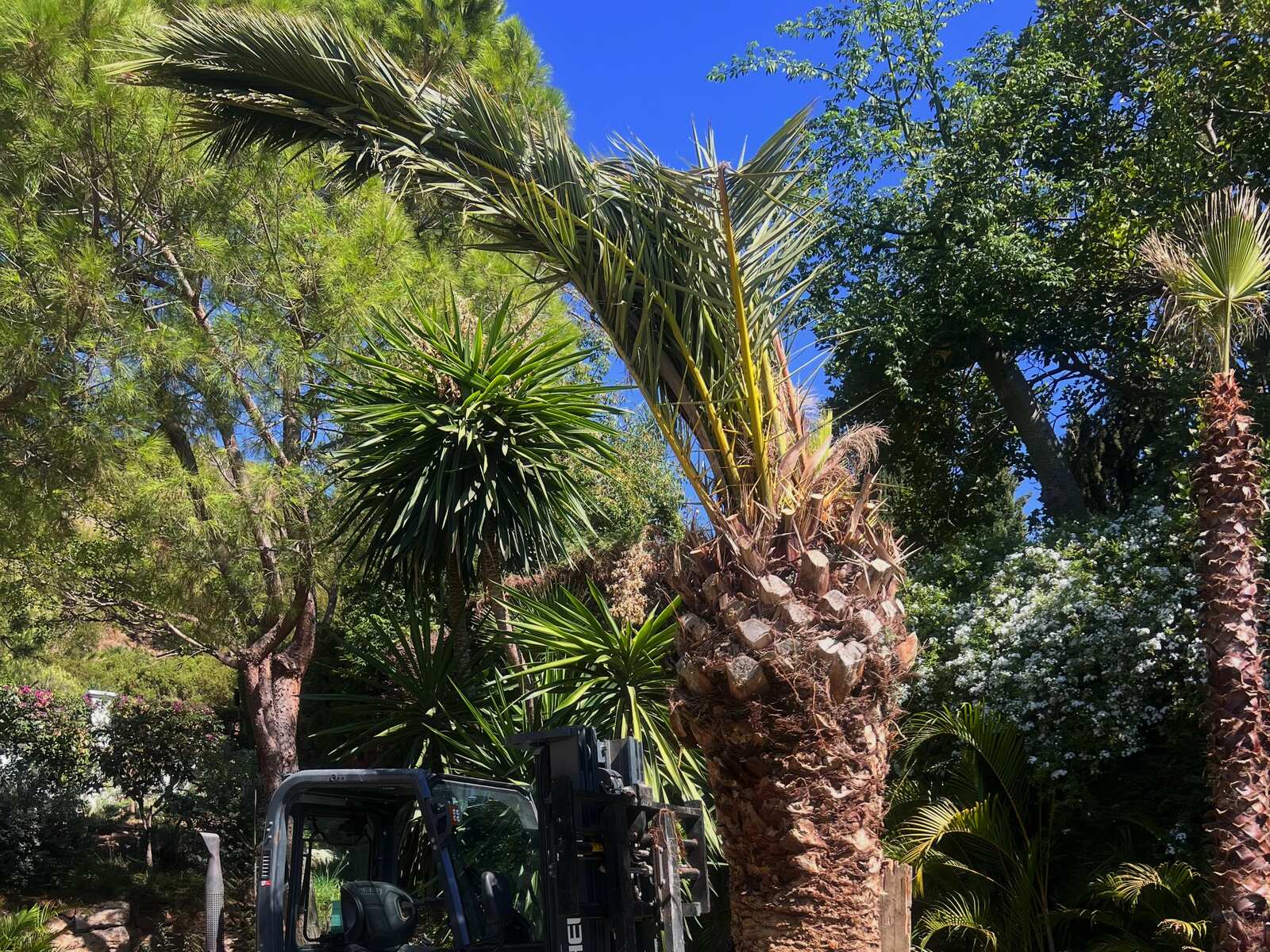
Palm tree pruning in Marbella has a season, and it starts in November. In Andalusia, Phoenix palms — the Canary Island date palm and the date palm that grow in almost every villa garden on the Costa del Sol — may only be pruned from November to February, and the same cool months are the best time to prune pines and most other large garden trees. In this article we explain why the season matters, what the Andalusian rules say, how to prune palms and pines without weakening them, what to expect from work at height, and how to plan the job so your garden is ready before spring.
Why palms and trees are pruned from November to February
The main reason is the red palm weevil (Rhynchophorus ferrugineus, picudo rojo). The Junta de Andalucía explains in its technical recommendations that weevil females prefer palms that are sick, weakened by a recent transplant or carrying fresh pruning wounds, and lay their eggs in soft tissue such as recent cuts. Every pruning cut on a palm is, in practice, an open door for the pest.
In the warm months the weevil is active and flies between gardens, so a freshly pruned palm in June is far more exposed than the same palm pruned in January. That is why Andalusian law limits pruning of the most sensitive palms to the cold season, when the insect is least active and wounds have time to dry and close before spring.
The same logic works for pines and other large trees. In winter, trees grow slowly, lose less sap and resin through the cuts, and many wood-boring insects are not flying. The structure of a deciduous tree is also easier to see without leaves. Pruning in winter means the tree starts the spring growth with clean, well-placed cuts instead of fighting stress in the summer heat.
What the rules say about pruning palms in Andalusia
The Andalusian Decree 77/2010 of 23 March on the red palm weevil sets out, in its Annex IV, how palms that are sensitive to the pest must be pruned. The main points are:
- Season: in the most sensitive species (Phoenix spp.) pruning may only be carried out from November to February.
- Only dry leaves: the general rule is to prune dry leaves only.
- No brushing of trunks: the trunks of sensitive palms may not be brushed or "peeled" to make them look smooth.
- Clean cuts: cuts must always be clean and must not tear the tissue.
- Green leaves only for safety: green leaves may be cut only when it is necessary for public safety, and the wound must then be treated with mineral oil followed by pruning mastic.
- Pruning waste: remains must be treated and transported covered to an authorised site.
The decree also makes the owner responsible: owners of sensitive plants must ensure that pruning on their property follows these recommendations (Article 7). In other words, if a gardener prunes your Phoenix palm in July or strips its green leaves, the responsibility does not stay only with the gardener. We describe the owner's other legal obligations — inspections, notification and removal of infested palms — in our article Red Palm Weevil: What Villa Owners in Andalusia Are Legally Required to Do.
How to prune a palm correctly
A well-pruned palm looks full and round, not like a feather duster on a stick. The most common mistake we see in gardens around Marbella is over-pruning: removing healthy green leaves to make the palm look "clean" for longer. Research from the University of Florida (UF/IFAS) shows that over-pruning reduces the palm's capacity for photosynthesis, can make the trunk thinner over the years, and leaves the crown more exposed to strong wind.
The main principles of correct palm pruning:
- Remove only completely dead leaves, plus flower and fruit stalks. The international pruning standard (ANSI A300), quoted by UF/IFAS, states that no leaves with tips above the horizontal — the "9 o'clock to 3 o'clock" line — should be removed.
- Leave half-yellow lower leaves if the palm is otherwise healthy. They usually indicate potassium deficiency; the palm takes potassium from these leaves, and removing them speeds up decline. The right answer is fertilising, not cutting.
- Cut close to the trunk without damaging it, never pull leaves off and never cut into the trunk.
- Never use climbing spikes on palms. Spike wounds in a palm trunk do not heal and can let in diseases and pests, including weevils.
- Disinfect tools between palms, so that a disease is not carried from one garden to the next.
- Protect the cut surfaces and keep up the preventive treatment against the weevil. The Junta recommends preventive treatments every 45–60 days, depending on technical criteria; pruning time is a good moment to check that the schedule is up to date.
Canary Island date palm and date palm (Phoenix)
These are the palms most attacked by the weevil and the ones covered by the November–February rule. They are usually cleaned once a year: dry leaves, old flower stalks and bunches of dates are removed, and the base of the old leaves is trimmed neatly to form the typical "pineapple" at the top of the trunk. The trunk itself is not brushed or peeled.
Washingtonia (fan palms)
Washingtonias grow fast and tall, and they keep their dry leaves hanging as a "skirt" along the trunk. This skirt holds dust, nests and pests and is a fire risk in summer, so it is removed regularly, together with the long flower stalks. Because of their height, Washingtonias almost always require work at height with ropes or a lifting platform.
Other palms
Queen palms (Syagrus) and similar species drop or hang their old leaves and need occasional cleaning. Palms with a smooth green "crownshaft", such as the king palm, normally shed their leaves by themselves and should not need pruning if they are properly fertilised.
Pine pruning: what, when and why
Stone pines and Aleppo pines give many villas in Marbella, Elviria, Sierra Blanca and La Zagaleta their character, but they also bring practical problems: branches over the roof or the pool, needles in gutters, shade over the lawn, and branches that break in winter storms. Pine pruning is best done in the cool months, from late autumn to the end of winter.
A good pine pruning job usually includes:
- removing dead, broken and diseased branches;
- removing branches that rub against each other or against the house;
- creating clearance over roofs, terraces, pools and paths;
- gently thinning the crown so that wind passes through it, instead of cutting the top.
Topping a pine — cutting the main trunk or the top of the crown — permanently damages its shape and creates large wounds. As a general rule in arboriculture, only a limited part of the living crown is removed in one season, and a tree that needs more work is pruned in stages over several years.
Pine pruning waste must not be left lying in the garden. Fresh pine wood attracts bark beetles, and forestry services insist that wood from affected pines is removed or debarked before a new generation of insects emerges. Winter is also the moment to look for the white silk nests of the pine processionary caterpillar; nests should be removed by professionals with protective equipment, as the caterpillars' hairs are highly irritating to people and pets.
Other garden trees: ficus, olive, carob and jacaranda
Most other large trees in Costa del Sol gardens are also pruned between late autumn and the end of winter. Olive and carob trees are pruned to open the crown to light and air, ficus trees to control their size and keep branches away from the house, and jacarandas to remove dead wood and improve their shape before flowering. We avoid heavy pruning in summer: large cuts in the heat stress the tree and can cause sunburn on newly exposed bark.
Pruning is also often a matter of good relations with neighbours. Under Article 592 of the Spanish Civil Code, if the branches of a tree extend over a neighbouring property, the neighbour has the right to demand that they be cut back to the boundary, and may cut roots that enter their land. Scheduling boundary trees in the winter pruning plan avoids conflicts before they start.
Work at height: why safety matters
Many palms and pines on the coast are 10–20 metres tall, and some old Washingtonias are even taller. Pruning them is "poda en altura" — work at height — and in Spain it is regulated by occupational safety law, including Royal Decree 2177/2004 on the use of work equipment for temporary work at height. In practice this means trained operators, rope access techniques or lifting platforms, harnesses and fall protection, and a ground team that keeps the area safe.
For a villa owner, three things are worth checking before anyone climbs a tree in your garden:
- that the team uses ropes or a platform, not a ladder leaning against the trunk;
- that they do not use climbing spikes on palms;
- that the company has insurance covering work at height and possible damage to the property.
Good planning also protects the garden: lawns, flower beds, pool covers and paving are protected, falling branches are lowered on ropes where needed, and all waste is removed on the same day.
How we plan a pruning job, step by step
- Site visit. We inspect every palm and tree, check its health, height and access, and look for signs of weevil, bark beetles or processionary nests.
- Pruning plan. We agree which trees will be pruned, how much, and in what order, and fix dates within the November–February window.
- Preparing the site. We protect the lawn, pool and paving, and organise access for the platform or the rope team.
- Pruning. Palms are cleaned of dry leaves and stalks only; pines and other trees are pruned with clean cuts at the right points.
- Treatment. Where needed, cut surfaces are protected and the preventive weevil treatment is carried out or updated.
- Waste removal. All remains are removed from the property and transported covered to an authorised site.
- Follow-up. We note the next pruning date and the treatment schedule in the garden plan, so nothing is forgotten.
Pruning works best as part of regular garden maintenance: the same team sees the palms every month and notices early changes in the crown long before a problem becomes visible from the terrace.
Frequently asked questions
Can I prune my palm in summer? Not if it is a Phoenix palm: in Andalusia they may only be pruned from November to February. Other palms can technically be cleaned at other times, but in summer every fresh cut attracts the weevil, so we recommend the winter window for all palms.
How often should a palm be pruned? Most Phoenix and Washingtonia palms in gardens need one cleaning a year. Pruning more often usually means that green leaves are being removed, which weakens the palm.
Should the trunk of a palm be brushed or peeled? No. In sensitive palms brushing the trunk is not allowed by the Andalusian decree, and it creates wounds that attract pests.
Who removes the pruning waste? The company that does the work should remove all remains, covered during transport, to an authorised site. Palm and pine waste should never be left in the garden or on the street.
How much does palm or pine pruning cost? It depends on the number of trees, their height, access to the garden and the equipment needed. After a site visit we give a fixed quote for the whole job.
MAXIPROF has worked on the Costa del Sol since 2010 with its own teams and no subcontractors. We prune, plant and transplant palms and trees of any size, with the right equipment for work at height, and we plan pruning together with weevil prevention and the rest of the garden care.
We prune palms, pines and garden trees in Marbella, Benahavís, Estepona and Mijas. See our tree and palm care services and our pest control programme, or request a free site visit — or write to us on WhatsApp at +34 662 629 540. The season is short, so it is worth booking your pruning dates early.
Sources
- Junta de Andalucía — Decree 77/2010 of 23 March on the red palm weevil (Annex IV, pruning)
- Junta de Andalucía — Technical recommendations against the red palm weevil
- University of Florida, IFAS — Pruning Palms (T. K. Broschat, EP443)
- Generalitat Valenciana — Control of pine bark beetles
- BOE — Spanish Civil Code (Article 592)
- BOE — Royal Decree 2177/2004 on work equipment for temporary work at height