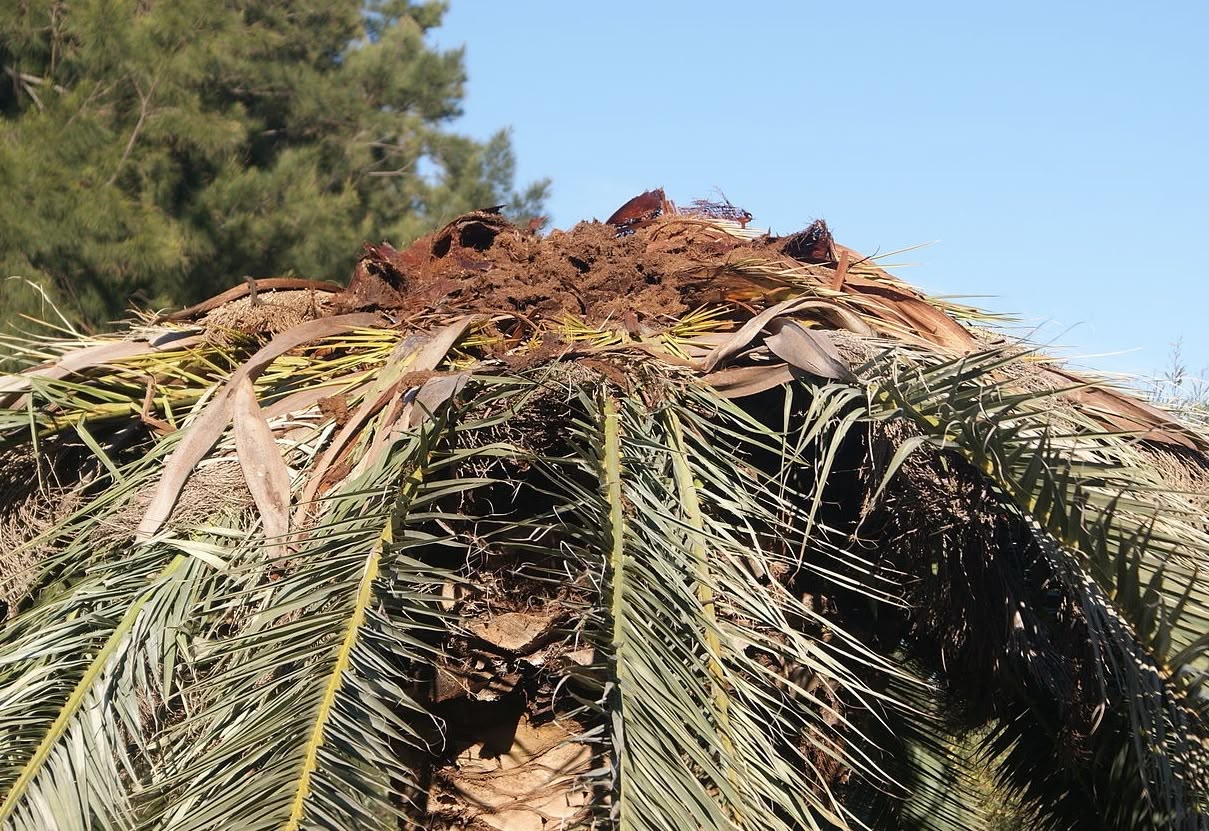
The red palm weevil is the biggest threat to palm trees in Marbella and across Andalusia, and the law requires owners to fight it. If your villa garden has palm trees — Canary Island date palms (Phoenix canariensis), date palms (Phoenix dactylifera) or other susceptible species — this concerns you directly. Since 2015 the whole of Andalusia has been officially declared a zone where the pest is present, and palm owners, private and municipal alike, must follow the measures set out in the regional Decree 77/2010 of 23 March. Below we explain what the law requires, how to recognise an infestation, which palm tree treatments actually work in Marbella and on the Costa del Sol, and what to do if a palm is already infested.
What the red palm weevil is and why it is so dangerous
The red palm weevil (Rhynchophorus ferrugineus, picudo rojo in Spanish) is a 2–4 cm beetle native to South-East Asia. It was first detected in Spain in the 1990s and has since spread along almost the entire Mediterranean coast. The female lays her eggs at the base of the leaves and in fresh wounds on the trunk — above all in recent pruning cuts. The larvae then bore tunnels through the crown and trunk, feeding on the palm's living tissue.
The real danger is that all of this happens inside the tree. A palm can look perfectly healthy for months, and by the time symptoms become visible the growing point (the apical bud) is often already damaged. Damage to the apical bud is fatal: no new leaves appear, and in advanced cases the whole crown can snap off and fall. On a villa plot that means not only losing a valuable mature tree but also a direct risk to people, cars and the swimming pool.
The worst affected species is Phoenix canariensis — exactly the palm most often found in gardens in Marbella, Benahavís, Estepona and Mijas. Date palms are also susceptible. Washingtonia palms are attacked far less often, but they are not immune. The wild dwarf fan palm (Chamaerops humilis) growing in natural stands is excluded from the decree's list of susceptible plants.
Signs of infestation: what to look for during an inspection
The Junta de Andalucía recommends checking the outside of every palm at least once every 30 days. During the inspection, look for:
- Central young leaves that are underdeveloped, partly eaten or wilted.
- Older leaves that turn yellow, droop and come away from the trunk easily.
- Larval tunnels at the leaf bases, fibre cocoons, adult beetles or compacted chewed fibre.
- Exit holes on the trunk and a reddish, sticky liquid oozing out.
- A strong, unpleasant fermenting smell — and, in a quiet garden, sometimes a crunching sound made by feeding larvae.
- A collapsing crown: the leaves splay out like an open umbrella and the top leans. This is already a late stage.
Some of these signs resemble fungal diseases, transplant stress, drought or damage from other larvae. That is why any suspicious palm should be checked by a specialist, not just by whoever mows the lawn.
What palm owners are legally required to do
Owners' duties are listed in Article 7 of Decree 77/2010. Article 9 adds measures for demarcated zones, and a resolution of 13 November 2015 (BOJA No. 240 of 14 December 2015) declared the whole of Andalusia a demarcated zone. In practice this means:
- Report symptoms. The signs listed in Annex III of the decree must be reported to the Plant Health service (Sanidad Vegetal) of the Consejería de Agricultura — for Marbella, the Delegación Territorial in Málaga.
- Allow inspections. Owners must give authorised staff access to the property.
- Carry out the required measures. Infested palms must follow a treatment plan using authorised products. Annex VI recommends a maximum of 45 days between treatments, carried out by companies and applicators holding a plant protection products licence.
- Prune correctly, following the rules of Annex IV (see below).
- Remove a palm that cannot be saved. If the damage prevents recovery and creates a serious risk of spreading the pest, the palm must be destroyed following the technical procedure in Annex V.
- Do not transplant without permission. Moving susceptible palms out of a demarcated zone requires prior authorisation from the provincial office, and the transplanted palm must be treated beforehand and kept on a regular treatment plan.
- Do not plant new susceptible palms where suspicious symptoms have already been found.
Under Article 9.4 of the decree, the owner pays for treating, removing and disposing of infested palms. Breaches are classed under Law 43/2002 on plant health: minor offences (such as neglecting the palms or failing to report the pest) carry fines of up to €3,000, and serious offences (ignoring required measures, giving false information, moving plants without authorisation) from €3,001 to €120,000. Some town halls run assistance programmes, so check the current conditions with yours.
Palm tree pruning: the rules that protect against the weevil
To a female weevil, a fresh cut smells like an invitation — which is why incorrect palm pruning remains one of the main causes of infestation in private gardens. The rules in Annex IV of the decree are:
- Prune only dry leaves. The palm needs its green leaves, and every unnecessary cut is a new entry point for the pest.
- Do not "shave" or dress the trunk for looks: it creates dozens of fresh wounds.
- If a green leaf has to be cut for safety reasons, treat the wound with mineral oil and then with pruning sealant (mastic de poda).
- Cuts must be clean, with no torn edges, and tools are disinfected between palms.
- Phoenix palms may be pruned only from November to February, when the beetles are least active.
- Pruning waste is treated and taken covered with plastic or mesh to an authorised landfill.
This is why palm pruning is best left to a crew that knows these rules rather than a one-off contractor. Professional tree surgery and palm pruning in Marbella covers the timing, wound treatment and waste removal.
How to protect palm trees: methods that work
There is no one-off "vaccine" against the red palm weevil. Protecting a palm is an ongoing programme that runs for years, as long as the pest is present in the area. It usually combines several methods at once.
1. Regular inspection
An inspection every 30 days is the foundation for everything else. The earlier an infestation is spotted, the better the chance of saving the palm. The easiest way is to include crown checks in your regular garden maintenance: the gardener is on site anyway, and the palms simply become one more item on the visit.
2. Preventive crown treatments
The classic method is a crown "bath": the solution is not sprayed but poured from above so that it fills the gaps between the leaf bases. A mature Canary palm with more than 3 m of trunk can need 20–30 litres. The Junta recommends treating every 45–60 days; in areas where the pest has not been seen for a long time, the interval can be extended.
One important point: many older guides recommend imidacloprid, chlorpyrifos and thiamethoxam. These substances are no longer permitted in the European Union — they were banned between 2018 and 2020. The list of authorised products changes, some are allowed only under temporary emergency authorisations from the Spanish Ministry of Agriculture, and most effective products are restricted to professional use. Treatments should therefore be carried out by a licensed applicator working from the current official register.
3. Biological control
Entomopathogenic nematodes, Steinernema carpocapsae, are microscopic worms that find the larvae inside the crown and kill them. Under the Junta's protocol they are applied from October to April, outside the hottest months, and where chemical products cannot be used they are applied in summer too, at least every 30 days. Products based on the fungus Beauveria bassiana, which infects larvae and adult beetles, are also used. Biological methods are safe for children, pets and the water in your swimming pool, but they need regular application and correct storage: nematodes are kept at 2–8 °C and never applied in the midday heat.
4. Endotherapy
In endotherapy the product is injected directly into the trunk through a small hole, and the palm's own sap carries it through the tissue. It is used both for prevention and for treating infested palms, but only with proper technique: incorrect drilling can kill the tree.
5. Pheromone traps
Traps baited with pheromone and a food lure show whether beetles are present in the area and in what numbers. They are placed at a distance from the palms so as not to draw the pest to the trees themselves. Traps are a monitoring tool, not a replacement for treatment.
Examples of red palm weevil control: what experience shows
The Canary Islands: the pest defeated
The weevil was found in the Canary Islands in September 2005 — in the patio of a private house in Las Palmas de Gran Canaria — and by the end of that year outbreaks had been detected on Gran Canaria, Fuerteventura and Tenerife. Over ten years the programme inspected 706,081 palms, treated 209,547, removed 659 infested trees and trapped 681 beetles. In September 2016 the Canaries declared the pest eradicated, one of the first places in the world to do so. The lesson for owners is simple: what works is a combination of widespread inspection, regular treatment and quick removal of palms that cannot be saved.
The Elche palm grove: early detection is decisive
In Elche, where the town hall owns around 126,000 palms, monitoring in the second half of 2019 found 119 palms infested by the weevil. About 63% of them had to be felled; the rest were treated with crown treatments and endotherapy. Around 90% of the affected palms were up to 4 m tall. Even under professional monitoring, only palms whose infestation is caught in time can be saved.
Typical situations on a villa
- Early stage. An inspection reveals a few chewed young leaves, but the growing point is intact. Usually a course of curative crown treatments every 45 days or so is prescribed, plus endotherapy and sanitation — removing the damaged tissue and treating the area — where needed. Such a palm can often be saved.
- Late stage. The crown has collapsed and the leaf bases are full of tunnels and cocoons. The palm cannot be saved, and the law requires it to be removed: the leaves are cut and bagged, the crown is treated, the waste is taken covered to a landfill and the stump is sealed.
- The owner lives abroad. The palms look healthy, but nobody has looked at them for six months. Here you need a fixed schedule: a monthly inspection, seasonal prevention and pruning only in the permitted months. This is part of our property management service for owners who are not at the villa all year round. Photo reports on the palms are available on request.
What to do after a palm has been removed
After an infested palm has been removed, replanting a new Phoenix canariensis in the same spot is not recommended: the decree specifically advises against new plantings of susceptible species where symptoms have been found. It is a good opportunity to rethink that part of the garden. Mediterranean plants, other palm species and a well-planned layout often look just as good and are easier to maintain. The change fits naturally into a landscape design project, together with adapting the irrigation system to the new planting.
Why prevention costs less than cure
A mature Canary palm takes decades to grow and cannot be replaced in a single season. Removing a dead palm, especially a tall one next to the house or pool, requires machinery, treatment and waste disposal — all at the owner's expense. By comparison, regular pest control for your garden costs considerably less. We have written in detail about what makes up the price of garden care in What Determines the Cost of Garden and Pool Maintenance in Marbella.
Frequently asked questions
Can I treat my palms myself? Most effective products against the red palm weevil are authorised for professional use only. Owners can inspect their palms and use the biological products available to non-professionals, but the treatment programme is best left to specialists.
How often are treatments needed? Usually every 45–60 days throughout the year. The schedule depends on the number of palms, their value and the situation in the area.
Do Washingtonia palms get infested? Less often than Canary palms, but cases are known, so every palm on the property is worth checking.
When should palms be pruned? Phoenix palms only from November to February, and only the dry leaves.
MAXIPROF looks after villa gardens in Marbella, Benahavís, Estepona and Mijas with its own crews — no subcontractors. We inspect our clients' palms regularly, prune them according to the rules and arrange preventive treatments against pests and fungal diseases. If you would like us to take a look at the palms on your property, get in touch.