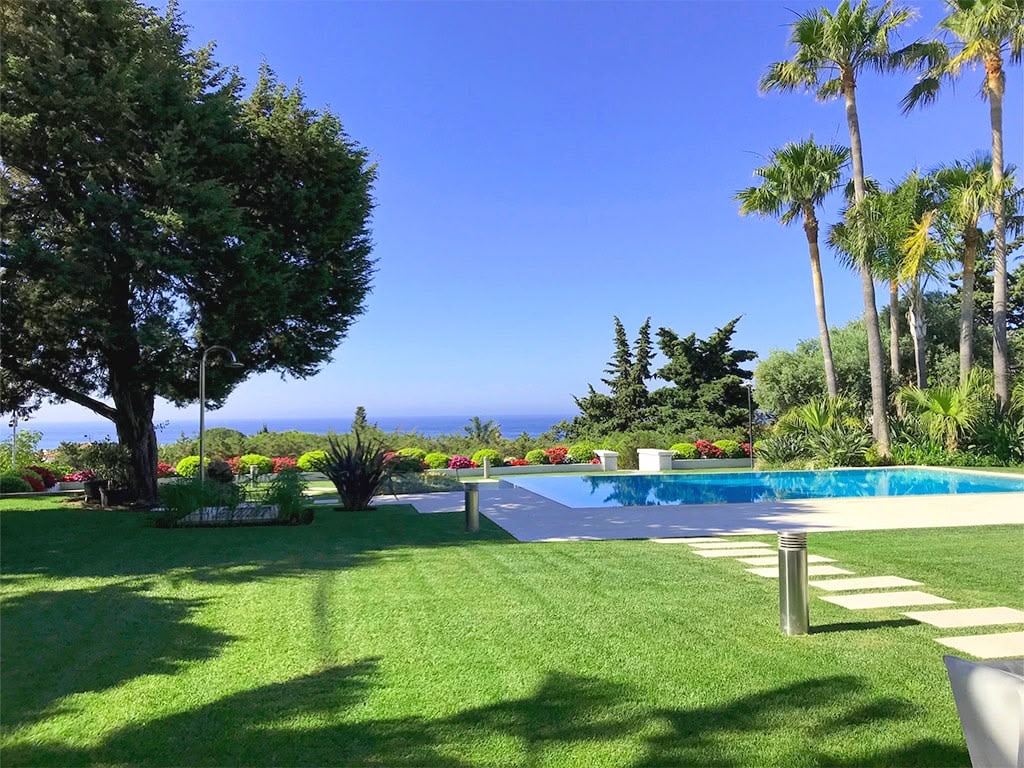
The cost of garden and pool maintenance in Marbella does not come down to a single price per square metre. It depends on a dozen factors: the slope of the plot, the number of palms and trees, the irrigation system, the pool, the area and how often the owner is at the villa. So you will not find a ready-made figure like "garden maintenance costs X euros a month" in this article. What you will find is everything you need to understand any quote: what the price is made of, which costs are often left out, how to compare offers from different companies and where you can sensibly save.
What garden maintenance includes
For some owners a "gardener" is someone who mows the lawn once a week. For others it means full technical care of the whole plot. Regular garden maintenance in Marbella usually includes:
- Lawn care: mowing on a schedule that follows the growing season, edging, aeration, feeding and reseeding bare patches.
- Pruning hedges, shrubs and ornamental plants — each species at the right time, not everything in a single visit.
- Checking trees and palms for early signs of pests and disease. Pruning tall trees and palms is a separate job, covered below.
- Feeding plants and caring for the soil according to the season.
- Checking and adjusting the irrigation: not just whether it works, but whether the schedule suits the current weather.
- Weeding and clearing leaves and green waste, including taking it away.
- Scheduled prevention of pests and fungal diseases.
- Seasonal planting and replacing plants, if this is part of the plan.
Two companies can give their service the same name — "garden maintenance" — and still sell a very different amount of work. That is why the first thing to compare is not the price but the list of what it includes.
Eight factors that determine the price
1. Size and layout of the garden
It is not only the size that matters but what fills it. Lawn, paved paths and gravel are maintained differently, and flower beds with complex planting, topiary or roses need far more manual work than the same area under Mediterranean ground cover.
2. Slope and access
A garden on a slope — for example in the hills of Marbella below the Sierra Blanca or in Benahavís — is physically harder to maintain than a flat plot. Terraces, steps and retaining walls slow the work down, some jobs can only be done by hand, and removing green waste takes longer.
3. Palms and tall trees
Palms are one of the biggest costs on Costa del Sol villas. Pruning tall palms needs lifting equipment or rope-access specialists, and under Andalusian law Phoenix palms may only be pruned from November to February. On top of that comes protection against the red palm weevil: regular inspections and treatments every 45–60 days. We explain the rules and methods in detail in Red Palm Weevil: What Villa Owners in Andalusia Are Legally Required to Do. Work on tall trees is usually quoted separately as tree surgery and palm pruning.
4. Irrigation system
A well-working automatic irrigation system with drip lines saves both water and the gardener's time. An old system with leaks, blocked sprinklers and manual taps does the opposite: it constantly needs repairs, and the plants suffer from either drought or overwatering. If the system is outdated, a one-off upgrade of the irrigation system often pays for itself through lower water use and fewer plant problems.
5. The garden's starting condition
A well-kept garden that simply moves from one company to another and an overgrown plot after a year without care are two different jobs. In the second case you first need a one-off revival: clearing, pruning, restoring the lawn and irrigation. Only then does it make sense to move to a regular plan.
6. Area and expected standard
In gated luxury estates such as La Zagaleta in Benahavís, the expected standard is usually higher: a perfect lawn without a single weed, regularly trimmed topiary, immaculate flower beds. That means more visits and more manual work. Logistics add to it too: security access, distance and estate rules on when noisy work is allowed.
7. Visit frequency and season
In summer the lawn and plants grow faster, irrigation works at full capacity and the pool is used every day — so visits are usually more frequent in the warm season than in winter. A good plan follows the seasons instead of fixing the same weekly visit all year round.
8. Swimming pool
Pool maintenance is a separate technical process: cleaning the floor, walls and waterline, testing and balancing the water, and servicing the filter, pump and automation. The price depends on the pool's volume, the type of filtration and disinfection, whether it is heated, and how many trees and palms around it drop leaves into the water. The pool is usually quoted separately from the garden, even when one company looks after both.
Costs that are often overlooked
- Materials. Plants, fertiliser, soil, mulch, pool chemicals and irrigation parts are billed separately in many plans.
- Green waste removal. Cuttings must go to an authorised collection point, and under Andalusian rules palm pruning waste must be transported covered. Check whether removal is included.
- One-off jobs. Pruning tall palms, removing dead trees, repairing the pool pump or replacing the pool lining are usually not part of the monthly plan.
- Water. The owner pays the water bill, and it depends directly on how sensibly the irrigation is set up. In dry years Andalusia restricts garden watering, and a garden designed to need a lot of water is the first to suffer.
- Tax. Services in Spain carry 21% IVA (VAT). When comparing offers, check whether prices include it.
Hourly rate or fixed plan
There are two main approaches. With an hourly rate you pay for the time actually worked. It is convenient for one-off jobs, but the budget is hard to plan and the invoice does not always show what was done in those hours. A fixed monthly plan sets out the scope of work and the visit frequency for a specific property. The owner knows the amount in advance, and the company is responsible for results rather than hours. One-off and seasonal work — planting, pruning tall trees, pest treatments — is usually quoted separately.
How costs change through the year
The annual garden budget is not spread evenly. In spring the garden wakes up: feeding, lawn renovation, seasonal planting and switching the irrigation to its summer schedule. Summer brings the most visits, irrigation runs at full capacity and the pool needs more frequent care. Autumn is the best time for planting and preparing the garden for the rains. In winter there are fewer visits, but this is when Phoenix palms and many trees are pruned. If you know this calendar in advance, large one-off jobs can be spread across the year and unexpected bills avoided.
How to compare offers from different companies
Before choosing a company, ask each one the same questions:
- What exactly is included in the monthly price, and what is charged separately?
- How many visits a month in summer and in winter, and how many people come?
- Is the work done by the company's own team or by subcontractors who change from job to job?
- Is green waste removal included?
- Do the specialists hold a licence to apply plant protection products? Without it, professional products cannot legally be used in your garden.
- Who looks after the irrigation and palms while you are away from Spain?
- Does the company have public liability insurance?
- Are prices quoted with or without IVA?
The answers say more about the future quality of care than the figure on the quote. The cheapest option often turns out to be expensive when, six months later, the lawn has to be restored or a dead palm removed.
Three typical scenarios
A compact villa on a flat plot
A lawn, a perimeter hedge, a few flower beds, a couple of olive trees and a pool. The owner lives at the villa most of the year. Such a garden usually needs a regular plan with weekly visits in summer and fewer in winter, plus separate pool maintenance. There are few one-off jobs, so the budget is predictable.
A large hillside plot with palms
Terraces, stone steps, a dozen Canary palms, a large pool and a complex irrigation system. Here regular care is joined by winter palm pruning, red palm weevil protection, zone-by-zone irrigation checks and more manual work on the slopes. The monthly plan is higher, and one-off work makes up a noticeable share of the annual budget, so it is worth planning in advance.
A villa the owner visits a few months a year
The garden and pool must keep working all year round, even when nobody is in the house. Someone needs to check the irrigation, the plants, the palms and the pool water regularly and spot problems in time — a leak, a broken pump, the first signs of pests. This care fits well with the scheduled visits and inspections of our property management service. Photo reports are available on request.
How to reduce costs sensibly
- Reduce the lawn area in favour of Mediterranean plants, gravel and mulch, which need less water and mowing.
- Switch the irrigation to drip lines and a controller with seasonal programmes.
- Don't postpone prevention: pest control against insects and fungal diseases costs less than replacing dead plants and palms.
- Plan one-off work for the right season: planting in autumn, palm pruning in winter.
- Think about maintenance when redesigning. Good landscape design considers not only how the garden looks but also how much it will cost to maintain for the next ten years.
Frequently asked questions
Why can't you give an average price per square metre? For the same area, slope, number of palms, irrigation and location can multiply the amount of work. An average figure is more likely to mislead than to help.
Is the pool included in the garden maintenance plan? It is usually a separate service. Check whether it is part of the overall invoice.
Do I have to pay for visits while I'm away from Spain? Yes: the garden and pool need care whether or not you are living at the villa. A gap in maintenance is the most common cause of expensive restoration work later.
How much does a site assessment cost? Our visit to your property and a personalised plan are free of charge.
MAXIPROF has worked since 2010 with its own crews and no subcontractors: gardeners, arborists, pool technicians, builders, welders, carpenters, plumbers and electricians. We draw up a fixed plan for each property, taking into account its slope, palms, irrigation and pool, and tell you in advance which work is charged separately.
We look after villa gardens and pools in Marbella, Benahavís, Estepona and Mijas. An exact price for your property can only be given after a site visit. Request a free visit and quote — we will come, assess the property and send you a plan with a price.