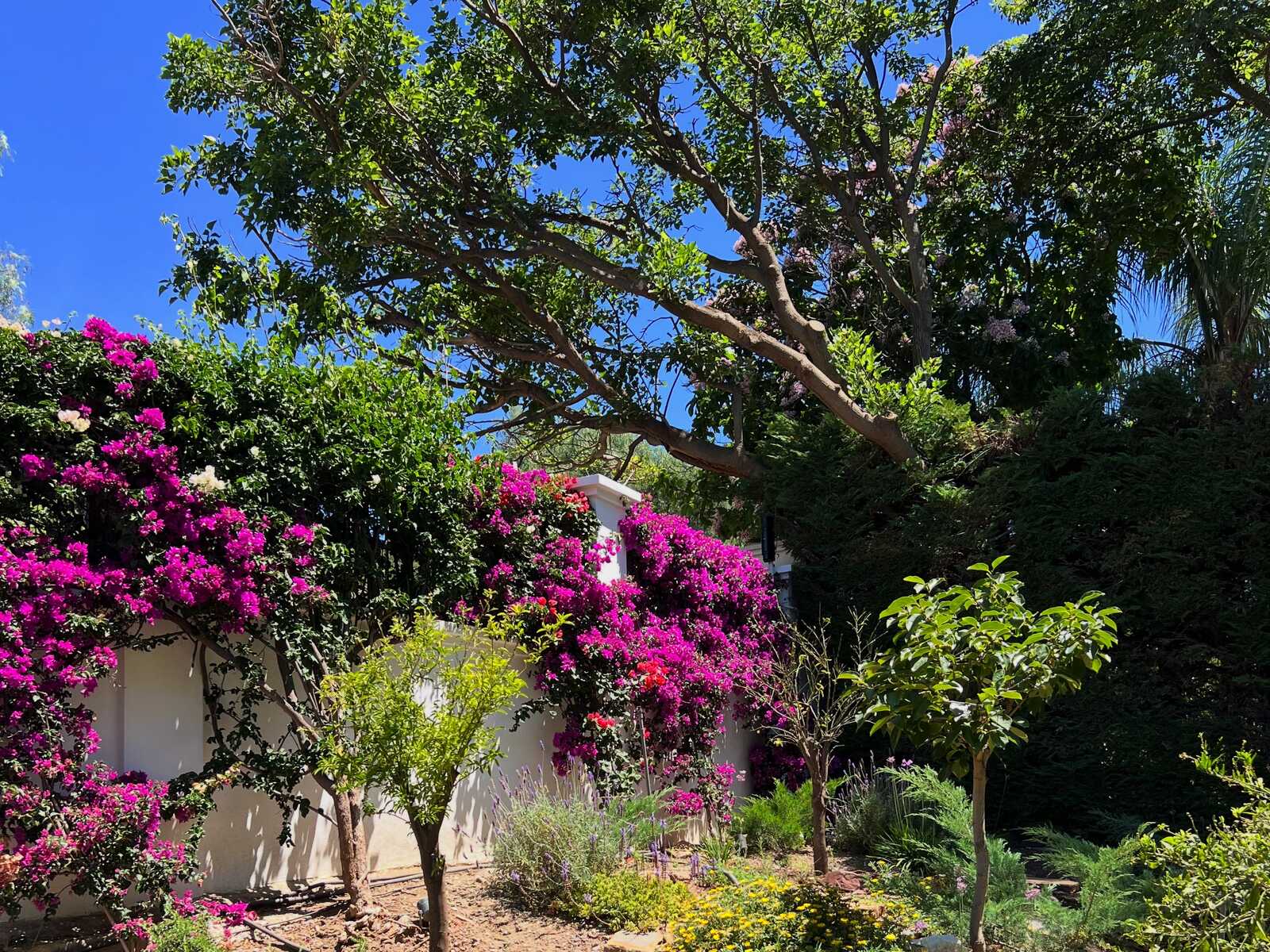
Luxury garden design in Marbella is not about planting as much as possible — it is about creating a garden that looks good in August, uses water wisely, frames the views and is easy to live with all year round. A villa garden on the Costa del Sol has to cope with a long dry summer, strong sun, sea wind, often a steep slope, and sometimes a pine forest next door. In this article we share the design ideas that work best here: the Mediterranean garden, small gardens and patios, gardens with stone and gravel, green walls and vertical gardens, and the details that turn a garden into a luxury one. At the end we explain how a garden design project works, step by step.
What makes a good villa garden on the Costa del Sol
Good landscaping in Marbella starts with the climate. Summers are hot and almost rainless: AEMET's climate normals for Málaga Airport show practically no rain in July and only a few millimetres in June and August, while most of the year's rain falls between October and April. A garden designed for a rainy climate will either need a lot of water or will look tired by midsummer.
The second factor is the site. Many villas in Marbella, Benahavís and Estepona are built on slopes, with terraces, retaining walls and views to the sea or the mountains. A good design works with these levels rather than against them: it frames the view instead of blocking it, creates privacy where the neighbours are close, and gives shade where people actually sit.
The third factor is how the garden will be used and maintained. A garden for a family that lives in the villa all year is designed differently from a holiday home that is empty for months. Before choosing a single plant, we ask: where do you have breakfast, where do children play, which areas will be seen from the house, and how much care do you want the garden to need?
The Mediterranean garden: beauty with less water
The Mediterranean garden is the natural choice for the Costa del Sol, and it is far from the dry, grey garden many people imagine. Olive trees, carobs, citrus, bougainvillea, oleander, lavender, rosemary, sage, santolina, cistus, ornamental grasses and succulents give colour, scent and texture throughout the year, and once established they need much less water than lawn and tropical planting.
Spanish water-saving guides on xeriscaping ("xerojardinería"), such as the one published by the National Centre for Environmental Education (CENEAM), summarise the principles that also guide our designs:
- prepare the soil so that it holds water well;
- choose plants with modest water needs;
- limit lawn to the areas where it is really used;
- cover the soil with mulch — stone, gravel, bark or shredded prunings;
- group plants by water needs and water each group with the right system;
- create shade and shelter from the wind.
The results are significant: in projects analysed in Zaragoza, most xeriscape gardens were estimated to use more than 50% less water than conventional gardens. On the Costa del Sol, where water restrictions are a recurring possibility, this is not only an ecological choice but also a practical one. We explain how to keep a garden and pool in good condition during restrictions in Garden Irrigation and Pool Care During Water Restrictions on the Costa del Sol.
A Mediterranean garden does not have to give up green lawn completely. A well-placed lawn area near the terrace or the pool, surrounded by drought-tolerant planting, gives the feeling of a green garden while keeping the water bill under control.
Designing a small garden or patio
Not every villa has a large plot, and many townhouses and apartments in Marbella have only a patio or a terrace garden. Small gardens need even more careful design, because every square metre is visible and used. The ideas that work best:
- One clear idea. A small garden looks bigger when it has one style and a limited palette of materials and plants, instead of many small elements.
- Layers and height. A tree or a tall palm, a layer of shrubs and a layer of groundcover create depth. Climbers on walls add green without taking floor space.
- Built-in elements. Raised beds that double as seating, benches along walls and planters integrated in the paving save space and look tidy.
- Large pots and planters. In patios and on terraces, large containers allow trees and shrubs to grow where there is no soil, as long as they are connected to the irrigation.
- Light. Garden lighting makes a small garden usable in the evening, which is when it is enjoyed most in summer.
Gardens with stone and gravel
Stone is part of the Andalusian landscape, and it is one of the best materials for a garden in a dry climate. Natural stone paths and steps, dry stone walls on slopes, boulders among planting and gravel mulch between shrubs give structure to the garden all year, including in winter when some plants rest.
Gravel and stone mulch also have a practical function. According to the CENEAM guide, covering the soil reduces water losses by evaporation and helps control weeds, and inert mulches such as stone and gravel last much longer than organic ones. In a Mediterranean garden, a layer of gravel over a weed membrane and drip irrigation underneath is one of the most effective combinations.
A few points to keep in mind:
- light-coloured gravel reflects heat and light, so it is best used with plants that like full sun;
- stone surfaces must let rainwater soak in or drain away — on slopes, drainage is planned together with the walls and paths;
- local stone looks natural in the landscape and ages better than imported materials chosen only for their look on day one.
Green walls and vertical gardens
Green walls are one of the most frequent requests in modern villa gardens: they soften boundary walls, hide neighbours, cool facades and bring planting into small spaces. The Royal Horticultural Society (RHS) distinguishes three main types:
- Direct greening — climbers that attach themselves directly to the wall;
- Indirect greening — climbers grown on trellises or wires fixed slightly away from the wall;
- Living wall systems — plants grown in modules, planter boxes or felt panels fixed to the wall.
On the Costa del Sol, the first two options are usually the most reliable: bougainvillea, star jasmine, plumbago, climbing roses or Virginia creeper on wires or trellises create a green wall that is easy to maintain. Living wall systems give a spectacular, architectural result, but as the RHS notes, they are the most engineered and costly option, often need their own irrigation system and benefit from professional installation and maintenance. In a hot, sunny climate, their irrigation must never fail, so we design them with automatic drip irrigation and regular checks.
Details that make a garden feel luxurious
What clients usually describe as "luxury garden design" is rarely about expensive plants. It is about details planned from the first sketch:
- Views and privacy. Hedges and trees placed to hide what you do not want to see and to frame the sea or the mountains.
- Lighting. Uplighting on trees and palms, path lighting and soft light around the pool change the garden completely after sunset. See our outdoor lighting service.
- Hidden infrastructure. Drip irrigation, cables and drainage installed before planting, so nothing is visible. We design them together with our irrigation systems team.
- The pool area. Planting that does not drop leaves into the water, shade where people rest, and materials that stay cool under bare feet.
- Mature plants. Specimen olive trees, palms or large shrubs give the garden a finished look from the first day. We plant and transplant large trees and palms with the right equipment.
Gardens on slopes and near pine forests
Hillside villas in Benahavís, La Zagaleta, Sierra Blanca or the hills above Estepona need special attention. Terraces and retaining walls hold the soil, drainage carries away heavy autumn rain, and groundcover planting protects slopes against erosion.
Many of these villas are also close to forest. Andalusian Law 5/1999 on forest fire prevention defines a "Forest Influence Zone" — a 400-metre strip around forest land — and requires owners of houses and developments within it to adopt preventive measures against fire. In the garden this means a sensible design: keeping a clear, well-maintained zone around the house, avoiding dense masses of dry vegetation next to walls and terraces, keeping irrigated planting closest to the building, and removing dry branches and dead vegetation regularly.
How a garden design project works, step by step
- Site visit and briefing. We walk the garden with you, look at the sun, the slopes, the soil, the views and the existing plants, and listen to how you want to use the garden.
- Concept. We propose the overall layout and style: zones, paths, terraces, planting areas, lawn and pool surroundings.
- Planting plan and materials. We choose plants for the Mediterranean climate and materials for paving, walls and gravel, and plan irrigation, lighting and drainage from the first sketch.
- Budget and stages. We prepare a detailed quote. A large garden can be built in stages, starting with structure and infrastructure.
- Construction and planting. Our own team builds the garden — from earthworks and walls to the last plant — so the garden approved on paper is the garden that gets built. Autumn is the best season for planting, as we explain in Autumn Planting and Lawn Renovation on the Costa del Sol.
- Care after planting. New planting needs close attention in its first year. The same team can go on to care for the garden through regular garden maintenance.
Frequently asked questions
How much does garden design cost in Marbella? It depends on the size of the garden, the slope, the materials, the size of the plants and the infrastructure needed. After a site visit we prepare a detailed quote, and the work can be divided into stages.
Does a Mediterranean garden look dry? Not when it is well designed. Evergreen shrubs, flowering climbers, aromatic plants and well-placed trees keep the garden green and colourful, and a small lawn area can be kept where it is really used.
Can a green wall be maintained easily? Climbers on wires or trellises need little more than pruning and drip irrigation. Modular living walls need a reliable irrigation system and regular professional checks.
When is the best time to build a new garden? Hard landscaping can be built at any time of year, but planting is best done in autumn, so plants have the winter and spring to root before the summer heat.
Can you redesign only part of the garden? Yes. Many projects start with one area — a terrace, the pool surroundings or a front garden — and continue later.
MAXIPROF has designed, built and maintained gardens on the Costa del Sol since 2010 with its own teams and no subcontractors. We design for the Mediterranean climate and for how you live in your villa, and the team that builds the garden can go on to care for it season after season.
We design and build villa gardens in Marbella, Benahavís, Estepona and Mijas. Learn more about our landscape design service or request a free site visit — you can also write to us on WhatsApp at +34 662 629 540.
Sources
- AEMET — Climate normals, Málaga Airport (1981–2010)
- CENEAM, Ministry for the Ecological Transition — Jardinería con menos agua (Gardening with less water)
- Royal Horticultural Society — Green walls
- BOE — Andalusian Law 5/1999 on forest fire prevention