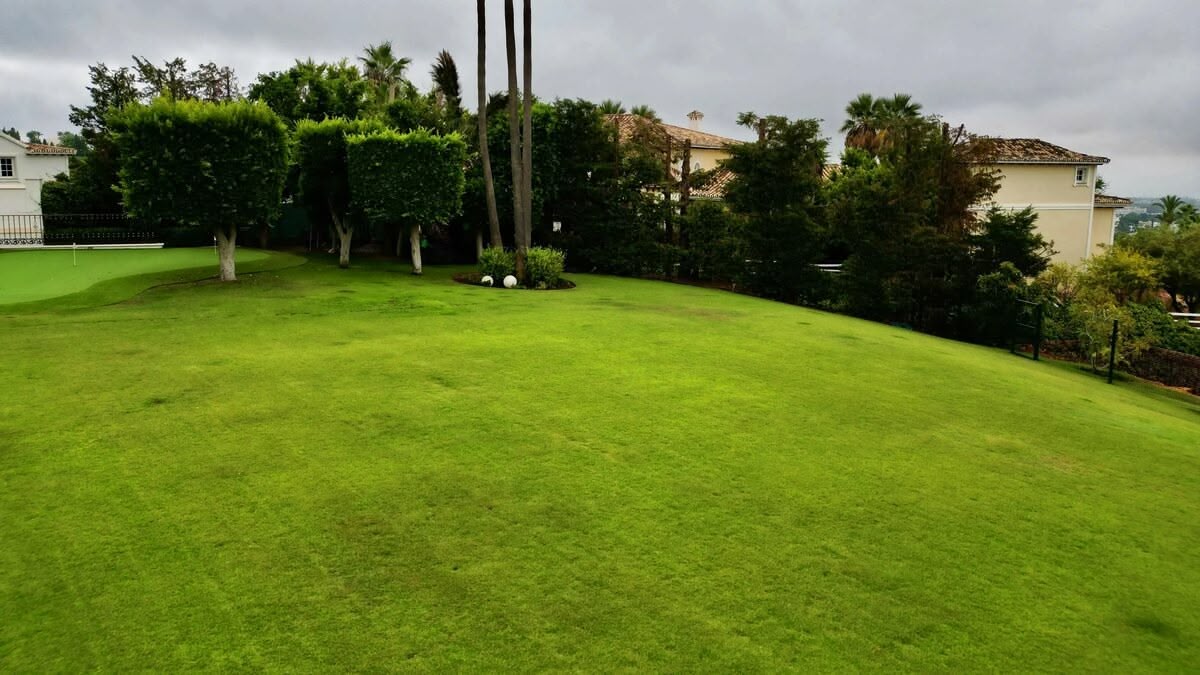
Autumn planting and lawn renovation on the Costa del Sol make the most of the best gardening season of the year in Marbella. After a long, dry summer, October and November bring warm soil, mild days and the first real rain, and plants planted now have the whole winter and spring to build roots before the next heat. In this article we explain why autumn suits planting so well, which plants and lawn types to choose, how to renovate a tired lawn, what to leave for spring, and how to look after new planting until the rains take over.
Why autumn is the best time to plant on the Costa del Sol
The climate data explains it. According to AEMET's climate normals for Málaga Airport (1981–2010), the average temperature is still 19.5 °C in October and 15.7 °C in November, with average maximums of 24.1 °C and 20.1 °C. At the same time, the rain returns: about 57 mm in October and 100 mm in November, after practically none in July and only around 6 mm in June and August.
That combination is ideal for new plants. The soil is still warm after the summer, so roots keep growing, while the air is no longer hot enough to stress the leaves. Rain gradually takes over part of the watering, and the plant reaches its first summer with a root system that has had six or seven months to develop. The UC Master Gardeners of Contra Costa County, who garden in a similar Mediterranean climate in California, give the same advice: planting in autumn gives plants time to become established and grow the healthy roots they need for the dry summer ahead, and new plantings should be watered regularly until the winter rains arrive.
Spring planting is possible, but plants then have only a few weeks before the heat of June. In a hot, dry summer, a shrub planted in May usually needs much more water to survive its first year than the same shrub planted in October.
What to plant in autumn
Trees and shrubs
Autumn is the right moment for most trees and shrubs sold in containers: olive and carob trees, citrus, oleander, pittosporum, viburnum, myrtle and most evergreen hedging plants. They establish before the summer and need less watering in their first year. It is also the time to fill gaps in existing hedges, so the new plants grow in line with the old ones by next summer.
Mediterranean and drought-tolerant plants
Rosemary, lavender, santolina, cistus, sage, westringia, agave, ornamental grasses and many groundcovers benefit most from autumn planting. Once established, they need very little water, which matters on a coast where restrictions are a recurring possibility. We describe the practical side of saving water in Garden Irrigation and Pool Care During Water Restrictions on the Costa del Sol.
Seasonal colour
For winter colour in beds and pots, autumn is the time to plant cyclamen, pansies, violas and other cool-season annuals, which flower through the mild coastal winter.
An exception: palms
Palms are the main exception to the "plant in autumn" rule. According to the University of Florida's IFAS extension service, container-grown palms can be planted at any time of year, but field-grown palms do best when planted in early summer, when the soil is warm. A large palm moved with a root ball is usually better planned for late spring or early summer. Autumn and winter, on the other hand, are the season for pruning: in Andalusia, Phoenix palms may only be pruned from November to February, as we explain in Red Palm Weevil: What Villa Owners in Andalusia Are Legally Required to Do.
How to plant so that new plants take
- Prepare the soil. Coastal soils are often sandy or heavy with clay. Loosen the planting area well beyond the size of the root ball and mix in organic matter, so roots can spread and the soil holds water.
- Plant at the right depth. The top of the root ball should sit level with the surrounding soil. The IFAS guidance for palms is the same principle that applies to most plants: plant at the depth the plant was growing in its container.
- Water in thoroughly. Water immediately after planting so the soil settles around the roots, even if rain is forecast.
- Add drip irrigation. One or two drippers per shrub and a ring of drip line around each tree deliver water to the roots without wetting paths or walls.
- Mulch. A layer of bark, wood chips or gravel keeps the soil moist, cooler and freer of weeds.
- Stake trees if needed. Young trees on exposed coastal plots benefit from a stake for the first year, tied loosely so the trunk can still move.
Lawn renovation: what to do in autumn and what to leave for spring
Lawns on the Costa del Sol fall into two broad groups, and the right season for work depends on which one you have.
Cool-season grasses
Tall fescue, perennial ryegrass and similar grasses grow best in mild temperatures. According to the University of California's integrated pest management programme (UC IPM), cool-season grasses grow best when seeded in September and October, with March to April as the next best time. Autumn is therefore the moment to reseed bare patches, thicken a thin lawn or sow a new one. UC IPM notes that perennial ryegrass establishes quickly and that fall seeding is preferred, while tall fescue tolerates heat stress well and grows in sun or partial shade. Both are bunch-type grasses, so bare areas do not fill in on their own and have to be reseeded.
Warm-season grasses
Bermudagrass, kikuyu, zoysia and St. Augustine grass are common choices in hot climates. UC IPM describes bermudagrass as drought tolerant, kikuyu as having good drought, heat and wear tolerance, zoysia as moderately deep-rooted and needing infrequent irrigation, and St. Augustine as the most shade-tolerant warm-season grass. Their weakness is winter: common bermudagrass and zoysia go dormant and lose colour in cold weather. These grasses are best seeded from mid-April to mid-May, so the main renovation of a warm-season lawn belongs in spring, not autumn.
Overseeding for a green winter
If your lawn is a warm-season grass that turns brown in winter, it can be overseeded in autumn with a cool-season grass, usually ryegrass, to keep it green until spring. UC IPM describes the basic sequence: mow closely and rake up debris, dethatch and aerate, then seed, fertilise and irrigate. Keep in mind that overseeding means extra water, mowing and feeding through the winter, so it is a choice about appearance rather than a necessity.
Turf (sod)
Ready-made turf gives an instant lawn. UC IPM notes that sod can be laid at any time of year, but it is best to avoid very hot or very cold weather, and on hot days the soil should be watered just before laying so the roots do not sit on dry, hot ground. On the coast, that makes October and November one of the best windows for laying new turf.
A typical autumn lawn plan
- Assess the lawn after the summer: bare patches, compacted areas, weeds, shade and irrigation coverage.
- Fix the cause first — a broken sprinkler, too much shade, poor drainage — otherwise new grass will fail in the same spot.
- Aerate and scarify compacted or matted areas.
- Reseed or overseed with a grass that suits the existing lawn and the amount of sun.
- Water lightly and often until the seed germinates, then switch to deeper, less frequent watering.
- Reduce the irrigation programme once the rains start; many systems keep running a summer schedule into November.
Should you keep a lawn at all?
A lawn is the most water-hungry part of most gardens. A trial by IMIDRA, the agricultural research institute of the Community of Madrid, put the water need of a standard temperate-climate lawn at almost six litres per square metre per day. Autumn is a good moment to rethink the layout: keep a lawn where people actually use it — beside the pool, for children, for play — and replace the rest with Mediterranean planting, gravel, paving or groundcovers. Good landscape design balances the look of a green lawn with the water and maintenance it will need over the next ten years.
Looking after new planting through the first winter
- Water until the rains take over. New plants need regular water for their first weeks; reduce it as soon as the ground stays moist after rain.
- Watch the irrigation after storms. Heavy autumn rain can wash out mulch and soil around young plants and block drippers.
- Check stakes and ties after strong winds.
- Look for pests and fungal problems. Mild, humid weather after a hot summer suits snails, slugs and fungal diseases; early pest control is cheaper than replacing plants.
- Do not overfeed. New plants first need roots, not a flush of soft leaves before winter.
An autumn checklist for villa gardens
- October: plan new planting and lawn work, check and repair the irrigation, start planting trees, shrubs and hedges, reseed cool-season lawns.
- November: continue planting, lay new turf, reduce the irrigation programme after the first rains, begin the palm pruning season.
- December: plant winter colour, mulch beds, clean drip filters, keep pruning Phoenix palms within the legal window.
- Spring: renovate warm-season lawns, plant large field-grown palms, check how autumn planting has established.
All of this is part of regular garden maintenance, and an irrigation system that is checked and adjusted each season keeps new planting alive with the least water. If you want to understand how planting and lawn work affect the budget, read What Determines the Cost of Garden and Pool Maintenance in Marbella.
Frequently asked questions
Is it too late to plant in November? No. In Marbella and along the coast, November is still mild and, together with December, the wettest month of the year on average, which makes it a very good month for planting trees, shrubs and hedges.
Can I sow a new lawn in autumn? Yes, if it is a cool-season grass such as tall fescue or ryegrass: UC IPM gives September and October as the best seeding months. Warm-season grasses such as bermudagrass are better sown from mid-April to mid-May.
Why is my lawn brown in winter? Many warm-season grasses go dormant and lose colour in cold weather. They recover in spring; if you want green all winter, the lawn can be overseeded with ryegrass in autumn.
Is autumn a good time to move a palm? Usually not. University of Florida guidance recommends planting field-grown palms in early summer, when the soil is warm. Autumn and winter are the season for pruning Phoenix palms in Andalusia.
Do new plants still need watering if it rains? Yes, until the rains are regular. A short shower wets only the surface; check the soil around the root ball before switching the irrigation off.
MAXIPROF has worked on the Costa del Sol since 2010 with its own crews and no subcontractors. We plan autumn planting and lawn work around each garden's soil, sun, slope and irrigation, and adjust the watering programme as the season changes.
We plant and maintain villa gardens in Marbella, Benahavís, Estepona and Mijas. If you are planning new planting, a lawn renovation or a garden redesign this autumn, request a free site visit — we will assess the garden and suggest a plan and a timetable for your property.
Sources
- AEMET — Climate normals, Málaga Airport (1981–2010)
- UC Master Gardeners of Contra Costa County — Fall is a Great Time to Plant (2022)
- UC IPM, University of California — Seeding time for turfgrasses, Turfgrass species, Overseeding and Sod
- University of Florida IFAS — Planting palms
- Community of Madrid / IMIDRA — Research on lawn varieties that save water (2017)