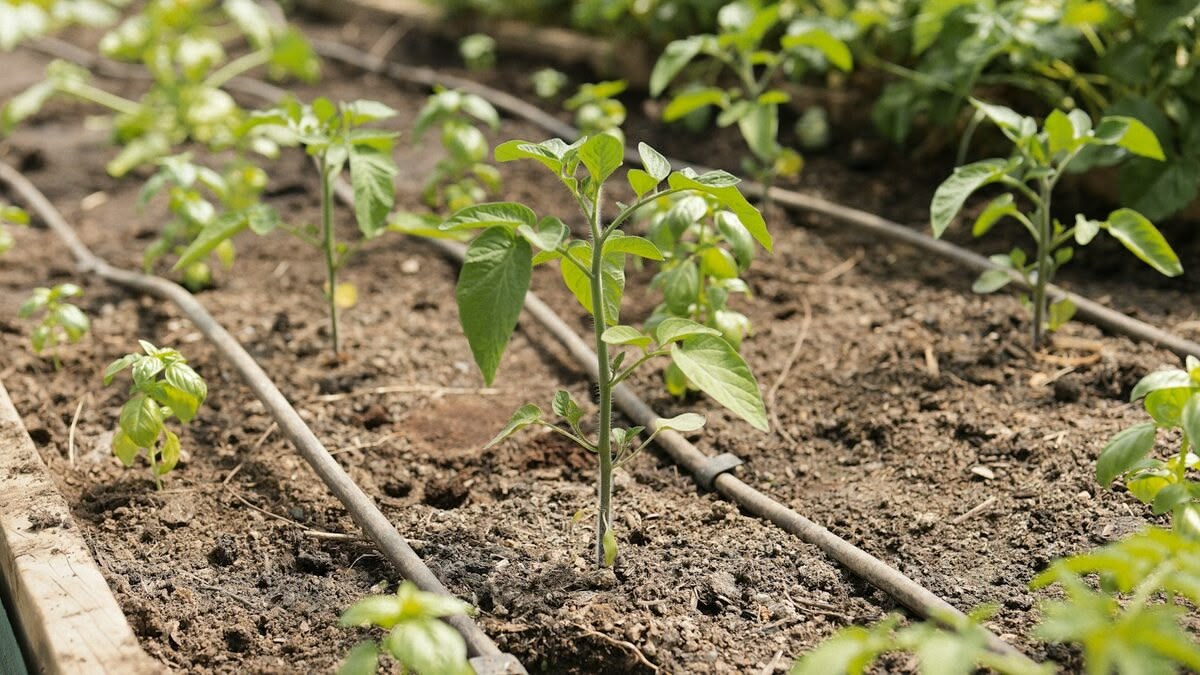
Garden irrigation and pool care during water restrictions are now a practical question for every villa owner in Marbella and along the Costa del Sol. The drought of 2023–2024 showed how quickly the rules can change: in a few months, owners went from normal use to a ban on watering gardens and filling pools with drinking water, and then to exceptions with strict conditions. This article explains how water restrictions work on the western Costa del Sol, what the official data says, and what can be done in the garden and the pool to use less water without losing plants, palms or water quality.
Why water is a recurring issue on the Costa del Sol
The climate itself explains a lot. According to AEMET's climate normals for Málaga Airport (1981–2010), the area receives about 534 mm of rain a year, but almost all of it falls between October and April. June gets around 6 mm, July practically none, and August about 6 mm. In other words, the garden needs the most water exactly when it does not rain, and the average July maximum is above 30 °C.
The western Costa del Sol depends on a small number of sources. The main reservoir, La Concepción near Istán, has a capacity of about 62 hm³. On 5 October 2026 it held around 30 hm³ (48%), compared with 61% in the same week of 2025, according to the weekly official data published by embalses.net. The second pillar is the Marbella desalination plant, which Acosol has been bringing back to its design capacity: from 6 hm³ a year to 12 hm³ and then to 20 hm³, enough to cover roughly 15–20% of the area's needs.
This combination makes the system sensitive to dry years. Two or three winters with little rain are enough for the authorities to start reducing the allocation per inhabitant and limiting outdoor uses — and gardens and pools are always among the first.
How water restrictions work in Andalusia
Restrictions are not decided by each owner's water company alone. The Junta de Andalucía declares the drought status of each supply system in the Andalusian Mediterranean basins, and the municipalities and the supplier — Acosol, the public company of the Mancomunidad de Municipios de la Costa del Sol Occidental — apply the measures locally. The scale goes from normal to moderate shortage (pre-alert), severe shortage (alert) and serious shortage (emergency). Each level comes with a maximum allocation in litres per inhabitant per day and a list of permitted and prohibited uses.
A short timeline of the last drought shows how this works in practice:
- November 2023. The 11 municipalities of the western Costa del Sol, including Marbella, Benahavís, Estepona and Mijas, adopted a joint decree. It banned the use of drinking water to irrigate gardens, parks and golf courses, to fill or top up swimming pools, to hose down streets, to wash cars outside authorised businesses and to run ornamental fountains. The aim was to cut drinking water use by 20%.
- Spring 2024. After the rains, the system moved from serious to severe shortage. The Junta order of 22 May 2024 (BOJA no. 102) set a maximum of 225 litres per inhabitant per day. From 1 June 2024, private pools could be topped up with prior authorisation, provided they had a recirculation system and used only the minimum water needed to replace evaporation and filter cleaning. Survival irrigation of green areas with plants of special botanical interest was allowed once a week.
- October 2024. The drought commission cut the allocation from 225 to 200 litres per inhabitant per day, while keeping the exceptions for pools and survival irrigation as long as the limit was respected.
- February 2025. The system moved to moderate shortage with 225 litres per inhabitant per day; garden watering and pool filling were allowed again, with a call for responsible use.
- Spring 2025. The Junta order of 28 April 2025 (BOJA, 8 May 2025) returned the system to normal status with up to 250 litres per inhabitant per day. In its notice of 28 May 2025, Marbella council still recommended non-drinking water for gardens and green areas where available and limited irrigation of these areas to once a week, or twice where needed to protect trees. It also warned that earlier restrictions could return if consumption exceeded the limit.
Restrictions change with the reservoir levels, sometimes within weeks. Before planning new planting or filling a pool, check the latest notice from your town hall and from Acosol. Rules can also differ for private villas, communities of owners and public spaces.
Where the garden's water actually goes
In most villa gardens, the lawn is the biggest consumer. A trial by IMIDRA, the agricultural research institute of the Community of Madrid, put the water need of a standard temperate-climate lawn at almost six litres per square metre per day. For 300 m² of lawn, that is around 1,800 litres a day in summer — more than the allocation for seven people at 250 litres each. Trees, shrubs and Mediterranean plants need much less once they are established.
The second big source of loss is the irrigation system itself. The United States Environmental Protection Agency (EPA) warns against watering in the middle of the day, when the sun evaporates much of the water, and recommends checking the system every month for leaks and blocked or broken heads. A broken sprinkler head or a leaking pipe can lose more water in a week than a whole bed of shrubs uses in a month.
How to save water in the garden without losing plants
1. Audit the irrigation system
Start with a simple check: run each zone and walk the garden. Look for broken heads, sprinklers that wet walls and paving, puddles, damp spots that never dry and areas where the pressure is too high and the water turns into mist. Check the water meter at night, when no one is using water: if it still turns, there is a leak. A professional audit of the irrigation system usually pays for itself through lower consumption alone.
2. Switch from sprinklers to drip wherever possible
According to the EPA's WaterSense programme, microirrigation — drip lines, drippers and micro-sprays — uses 20 to 50 percent less water than conventional sprinkler systems and can save a typical home more than 25,000 gallons (about 95,000 litres) a year. Drip delivers water directly to the root zone, so less of it is lost to wind, evaporation and runoff. It is the best option for shrubs, hedges, flower beds, pots and young trees; sprinklers make sense only for the lawn.
3. Install a smart controller
A simple timer waters on the same schedule whether it rained yesterday or not. A weather-based controller adjusts the programme to temperature, rain and evaporation. The EPA estimates that replacing a standard clock-based controller with a WaterSense labelled weather-based model can save an average home nearly 7,600 gallons (about 28,800 litres) a year. Many models can be controlled from a phone, which is especially useful for owners who spend part of the year outside Spain.
4. Water at the right time and in the right way
- Early morning or late evening. Less evaporation, less wind and lower pressure in the network.
- Deeply and less often. Short daily watering keeps roots near the surface; longer, less frequent cycles train them to grow deeper and resist drought better.
- In short cycles on slopes. On terraced plots in the hills of Marbella and Benahavís, split the watering into two or three short cycles so the soil can absorb the water before it runs off.
- By zones. Group plants with similar needs into the same irrigation zone (hydrozones). A lawn, an olive tree and a bed of lavender should never share the same programme.
5. Protect the soil
Bare soil dries out quickly in the Andalusian summer. A layer of mulch — bark, wood chips or gravel — 5 to 8 cm thick reduces evaporation, keeps the roots cooler and slows weed growth. Adding organic matter when planting helps sandy coastal soils hold water for longer.
6. Set priorities for survival irrigation
If restrictions allow only minimal watering, not all plants are equally valuable. The usual order of priority is:
- Mature trees and palms — they take decades to replace, and a weakened palm is harder to protect.
- Young trees and recently planted shrubs, whose roots are still shallow.
- Hedges that provide privacy and shelter from the wind.
- Flower beds and seasonal plants.
- The lawn — it can go dormant and recover, or be replaced more cheaply than anything else.
Palms deserve special attention: stress from lack of water weakens them at the time when the red palm weevil is active. We explain the owner's legal obligations in Red Palm Weevil: What Villa Owners in Andalusia Are Legally Required to Do.
7. Rethink the planting
The most effective long-term step is to design the garden for the climate. Mediterranean and drought-tolerant plants — olive, carob, rosemary, lavender, santolina, cistus, agave, bougainvillea and many ornamental grasses — need far less water once established. Part of the lawn can be replaced with gravel, paving, ground covers or a smaller area of drought-tolerant grass. Autumn is the best time for this work: the soil is still warm, the rains are coming, and new plants have the whole winter to root. Good landscape design takes water use into account from the first sketch.
8. Use alternative water sources
- Rainwater. Each millimetre of rain on one square metre of roof equals one litre. A roof of 200 m² in an area with about 534 mm of rain could, in theory, collect around 100,000 litres a year — but almost all of it falls in winter, so storage tanks are needed to carry it into summer.
- Regenerated water. Treated wastewater is already used to irrigate golf courses and public green areas, and the 2024 Junta order allowed it for garden irrigation with administrative authorisation. It requires a separate network and permits.
- Wells and groundwater. Using a well requires the corresponding permits from the water authority; during droughts, groundwater is also subject to limits.
The swimming pool: how much water it loses and how to keep it
A swimming pool loses water mainly through evaporation, and the numbers are bigger than most owners expect. A study by researchers from Spanish universities and the University of Salzburg (Hof et al.), published in the journal Water in 2018, estimated evaporation of about 4.4 litres per square metre per day in the areas with the highest density of pools. For a typical private pool of 38–40 m², that is around 170 litres a day — more than a thousand litres a week in summer. The same study used 57,700 litres as the volume of a typical 38 m² pool with a depth of 1.5 m.
1. Cover the pool
The cover is the single most effective measure. According to the U.S. Department of Energy, pool covers reduce the amount of make-up water needed by 30–50% and can cut heating costs by 50–70%. A cover also keeps leaves and dust out, which means less cleaning and less filter backwashing. The Balearic study also noted that shading reduced evaporation by about 5–10%, so trees, pergolas and windbreaks around the pool help too.
2. Find and repair leaks
If the water level drops by more than usual, check for a leak with the bucket test. Place a bucket filled with water on the pool steps, mark the water level inside the bucket and the pool level on its outside, and switch off any automatic filling. After 24 hours, compare the two drops. If the pool has lost noticeably more than the bucket, there is a leak in the shell, the pipes or the fittings, and it is worth calling a technician.
3. Backwash only when needed
Every backwash of a sand filter sends a significant volume of pool water down the drain. Backwash by the pressure gauge, not by the calendar: when the pressure rises above the normal working level, the filter needs cleaning. Keeping the skimmer baskets clean and using a cover reduce the need for backwashing.
4. Keep the water balanced instead of replacing it
Many pools are drained simply because the water chemistry was neglected. Regular testing and balancing of pH, disinfectant and hardness keep the water usable for years. A full drain-and-refill should be the exception — and during restrictions it may be prohibited. In winter, the pool can be kept with a cover and reduced filtration rather than emptied.
5. Plan filling and topping up
If a pool has to be filled during a period of restrictions, check first with the town hall and Acosol which option is allowed. In 2024, private pools could only be topped up with prior authorisation and a recirculation system; for a full fill, one option is water delivered by tanker from an authorised source, if the municipality allows it. Regular pool maintenance keeps losses visible: a technician notices an unusual drop in level much earlier than an owner who visits the villa once a month.
A seasonal plan for water-wise villa care
- Autumn (October–November). Planting and lawn replacement, irrigation audit, repairs before the winter rains.
- Winter (December–February). Reduce or switch off irrigation when it rains, cover the pool, prune and clean the drip filters.
- Spring (March–May). Check every zone, adjust the controller to the rising temperatures, renew the mulch.
- Summer (June–September). Water early in the morning, watch the meter, keep the pool covered when not in use, prioritise trees and palms if restrictions apply.
When the owner is away
Most water is wasted in villas where nobody is watching: a broken pipe can run for weeks, a controller can keep a summer programme into the winter, and a pool can lose a significant volume through an undetected leak. Regular visits, meter readings and remote control of the irrigation reduce this risk. These checks are part of regular garden maintenance and our property management service for owners who live abroad.
Water saving also affects the budget. We explain how irrigation, the pool and the condition of the garden affect the cost of upkeep in What Determines the Cost of Garden and Pool Maintenance in Marbella.
Frequently asked questions
Can I water my garden during a drought? It depends on the drought status of the system and on the municipal notice in force. In the strictest phase of 2023–2024, the use of drinking water for garden irrigation was banned; later, survival irrigation was allowed once a week. Always check the current rules with your town hall and Acosol.
Can I fill my pool during restrictions? During the last drought, filling and topping up pools with drinking water was first banned and then allowed only with prior authorisation and a recirculation system. Water delivered by tanker from an authorised source can be an alternative, if the municipality allows it.
Is a pool cover really worth it? Yes. It is the most effective way to reduce evaporation: according to the U.S. Department of Energy, it cuts the make-up water needed by 30–50%, and it also keeps the pool cleaner.
Will my lawn die without water? Many lawns go dormant and turn brown, then recover when watering resumes, but a long drought can kill them. If restrictions are frequent, it is worth reducing the lawn area in favour of drought-tolerant planting.
What should I water first if water is limited? Mature trees and palms, then young trees and new plants, then hedges, and only after that flower beds and the lawn.
MAXIPROF has worked on the Costa del Sol since 2010 with its own crews and no subcontractors. Our gardeners and pool technicians check irrigation zones, controllers, meters and pool levels as part of regular maintenance, and adapt the programme to the season and to the restrictions in force.
We look after villa gardens and pools in Marbella, Benahavís, Estepona and Mijas. If you want to reduce the water your garden and pool use, request a free site visit — we will assess the irrigation, the pool and the planting and suggest a plan for your property.
Sources
- AEMET — Climate normals, Málaga Airport (1981–2010)
- Embalses.net — La Concepción reservoir, weekly data
- Junta de Andalucía — Order of 22 May 2024 on the drought status of the Andalusian Mediterranean basins (BOJA no. 102)
- Mancomunidad de Municipios de la Costa del Sol Occidental — Joint measures of the 11 municipalities, November 2023
- Marbella City Council — Measures for the drought status of the Costa del Sol Occidental system, May 2025
- iAgua / Europa Press — Marbella desalination plant: 20 hm³ a year
- Hof et al., Water (MDPI), 2018 — Swimming Pool Evaporative Water Loss and Water Use in the Balearic Islands (Spain)
- U.S. Department of Energy — Swimming pool covers
- U.S. EPA WaterSense — Microirrigation and Weather-based irrigation controllers
- Community of Madrid / IMIDRA — Research on lawn varieties that save water (2017)