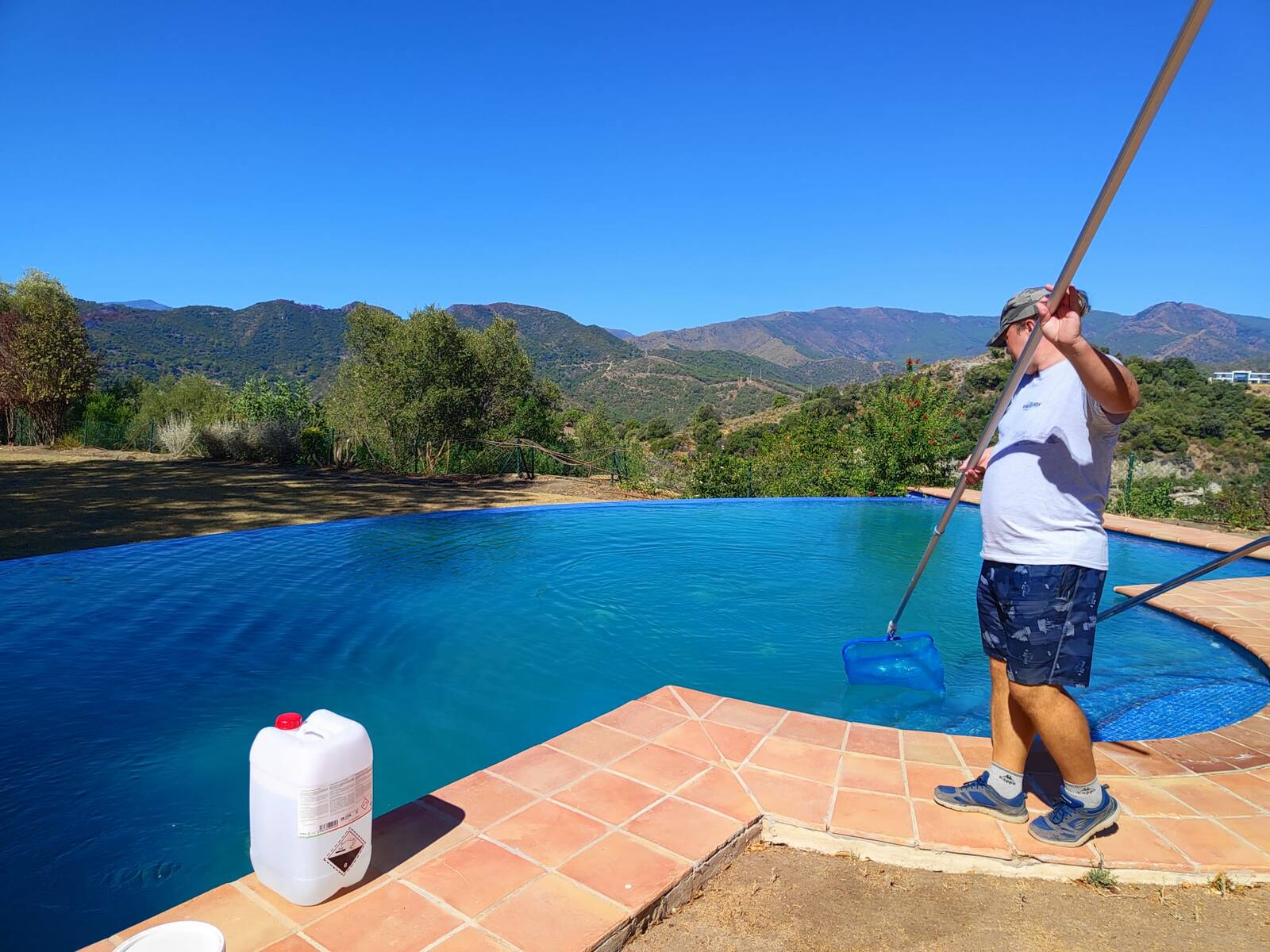
Salt chlorination or traditional chlorine — this is one of the most common questions villa owners in Marbella ask about their pool. The short answer is that both systems disinfect the water with chlorine; what changes is how the chlorine gets into the pool, how much handling it requires, and what has to be watched to keep the water balanced. In this article we explain how each system works, compare their advantages and drawbacks, list the water values worth keeping, explain the rules for community pools in Andalusia and give practical advice on switching from chlorine to salt and on pool water care in the cooler months.
How pool water disinfection works
A pool stays clean thanks to three things working together: circulation and filtration remove particles, a disinfectant kills bacteria and algae, and balanced water chemistry keeps the disinfectant effective and protects the pool and equipment. In almost all villa pools on the Costa del Sol, the disinfectant is chlorine.
When chlorine dissolves in water it forms "free chlorine", the active part that disinfects. As it works, part of it combines with sweat, sunscreen and other organic matter and becomes "combined chlorine" (chloramines), which disinfects poorly and causes the typical "chlorine smell" and eye irritation. A well-kept pool has enough free chlorine and very little combined chlorine.
The difference between the two systems is simply the source of the chlorine. In a traditional pool, chlorine is added as tablets, granules or liquid. In a salt pool, a salt chlorinator produces chlorine on site from salt dissolved in the water, by electrolysis. So a "salt pool" is not a chlorine-free pool: it is a pool that makes its own chlorine.
Traditional chlorine: how it works, pros and cons
Traditional chlorination uses chlorine products dosed by hand, with a floating dispenser or with an automatic dosing pump. The most common forms are:
- Slow-dissolving tablets (usually trichlor), which contain a stabiliser — cyanuric acid — that protects chlorine from sunlight;
- Granular chlorine, used for shock treatments and quick corrections;
- Liquid chlorine (sodium hypochlorite), often dosed automatically in larger pools.
Advantages: low initial cost, simple equipment, and it works the same in any water temperature.
Drawbacks: chemicals must be bought, stored and handled safely; chlorine levels go up and down between doses; and stabilised tablets gradually raise the level of cyanuric acid. When cyanuric acid builds up too much, chlorine loses effectiveness, and the only solution is to partially replace the water — a real problem in years of water restrictions.
Salt chlorination: how it works, pros and cons
A salt chlorinator consists of a control unit and an electrolytic cell installed in the pool's return pipe. Salt is added to the pool water once, and as the water passes through the cell, electrolysis turns the dissolved salt into chlorine. After disinfecting, chlorine turns back into salt, so salt is lost mainly through backwashing, splash-out and rain, not through daily use.
The salt level is much lower than in the sea. One leading manufacturer, AstralPool, recommends an optimum of 5 grams of salt per litre in its salt chlorinator manual, with a working range of 3 to 12 g/L — most swimmers hardly notice it.
Advantages:
- steady, automatic chlorine production, without buying and storing chlorine products;
- more stable chlorine levels and, in practice, fewer chloramines, so the water feels softer and smells less of chlorine;
- no build-up of cyanuric acid from tablets.
Drawbacks and things to watch:
- Higher initial cost: the chlorinator, and ideally an automatic pH controller.
- pH tends to rise in salt pools. The AstralPool manual recommends keeping pH between 7.2 and 7.6 and warns against prolonged operation above 7.6, which causes scale on the electrodes. That is why most salt systems are installed with an automatic pH regulator.
- The cell needs care: it is cleaned of scale periodically (many models reverse polarity automatically) and replaced at the end of its life.
- Cold water reduces output: the manual gives a working temperature of 15–40 °C; in winter the chlorinator produces less, which is usually compatible with the lower chlorine demand of cold water.
- Metals and natural stone: salt water can be aggressive to some metal fittings and certain types of natural stone around the pool, so materials should be checked before installation.
Salt or chlorine: a direct comparison
- Initial cost: chlorine — low; salt — higher (chlorinator and pH controller).
- Handling of chemicals: chlorine — regular buying, storing and dosing; salt — minimal: salt once a season and acid for pH.
- Chlorine level: chlorine — varies between doses; salt — steady and automatic.
- Cyanuric acid build-up: chlorine — yes, with stabilised tablets; salt — no, stabiliser is added only if needed.
- pH: chlorine — easier to keep stable; salt — tends to rise, a pH controller is recommended.
- Winter (water below 15 °C): chlorine — works normally; salt — lower output.
- Feel of the water: chlorine — more "chlorine smell" if poorly balanced; salt — softer, less smell.
- Main maintenance: chlorine — dosing and testing; salt — cell cleaning, pH and salt level.
For a villa that is lived in all year and has regular pool maintenance, a salt chlorinator with automatic pH control is usually the most comfortable option. For a pool that is used only a few months a year, or where the equipment room cannot take additional equipment, a well-managed traditional chlorine system can be perfectly adequate. The right choice depends on the pool, its use and its materials.
Water values worth keeping — and how often to test
Spanish Royal Decree 742/2013 sets the technical and sanitary criteria for pools. Its limits apply mainly to public and community pools, but they are a sensible reference for any private pool:
- pH: 7.2–8.0 (salt chlorinator manufacturers usually ask for 7.2–7.6);
- free residual chlorine: 0.5–2.0 mg/L;
- combined residual chlorine: no more than 0.6 mg/L;
- cyanuric acid: no more than 75 mg/L;
- turbidity: no more than 5 NTU — in practice, the bottom drain must be clearly visible.
pH matters as much as chlorine. The US Centers for Disease Control and Prevention (CDC) explains that chlorine kills fewer germs as pH rises, especially above 8.0, while too low a pH increases the risk of corrosion in pipes and equipment. That is why pH is always corrected first, and chlorine afterwards.
For home pools, the CDC recommends testing chlorine and pH at least twice a day during use. In practice, villa pools with automatic dosing are checked at every maintenance visit with a reliable test kit, and the automatic probes are calibrated regularly so that the equipment measures correctly.
Community pools: what the rules say in Andalusia
If your villa or apartment shares a pool with a community of owners, there are additional rules. Royal Decree 742/2013 classifies community pools as private pools of type 3A and requires them to comply with several articles, including those on water quality and control, while single-family pools (type 3B) must comply only with the article on incident situations.
In Andalusia, pools are also regulated by Decree 485/2019, which approved the Technical and Sanitary Regulation of Pools in Andalusia. According to the regional health authority, it covers pools of communities of owners with twenty or more homes, which must have a self-control protocol, and some provisions also apply to smaller communities. Incidents and the measures taken must be reported to the provincial health delegation within five days. For communities, it is worth having a maintenance company that keeps proper records of testing and treatment.
Switching from chlorine to salt: what to check
- The pool and its materials. Check metal fittings, ladders, lights and the stone around the pool for compatibility with salt water.
- The size of the chlorinator. The cell must match the pool volume and use; an undersized unit runs constantly and wears out faster.
- pH control. Plan an automatic pH regulator from the start; it is the key to a trouble-free salt pool.
- Water balance before the switch. If the water has a lot of cyanuric acid from years of tablets, it may need partial renewal before installing the chlorinator.
- Salt and start-up. Add the right amount of pool salt, let it dissolve, and set the production according to the season.
- Maintenance routine. Include checks of the salt level, cell condition and probe calibration in the regular maintenance plan.
Pool water care is closely linked to water consumption: a pool with balanced water and a cover loses less water and needs fewer refills. We explain this in Garden Irrigation and Pool Care During Water Restrictions on the Costa del Sol.
Pool water in autumn and winter
When the water cools down, bacteria and algae grow more slowly and chlorine demand falls. That does not mean the pool can be forgotten: circulation, filtration and a minimum level of disinfection must continue, especially after autumn rain, which brings leaves, dust and organic matter into the water. In salt pools, production is adjusted to the lower temperature, and in all pools pH and chlorine are still checked regularly. A good cover reduces both debris and chemical use.
Frequently asked questions
Is a salt pool chlorine-free? No. A salt chlorinator produces chlorine from salt; the water is disinfected with chlorine in both systems.
Does salt water taste or feel like the sea? No. The salt level in a salt pool is far lower than in seawater, and most people barely notice it.
Is salt chlorination cheaper? The initial investment is higher, but there is no need to buy chlorine products regularly. Over several seasons, the total cost is often similar, while the comfort is greater.
Can any pool be converted to salt? Most can, but the materials, the equipment room and the pool size must be checked first.
How often should the water be tested? pH and chlorine should be checked frequently during the season and at every maintenance visit; automatic probes should be calibrated regularly.
MAXIPROF has maintained pools on the Costa del Sol since 2010 with its own teams and no subcontractors. We work with both traditional chlorine and salt chlorination, check the water at every visit and adjust the treatment to the season, the use of the pool and its materials.
We look after pools in Marbella, Benahavís, Estepona and Mijas. Learn more about our pool maintenance service and what determines the cost of garden and pool maintenance, or request a free site visit — you can also write to us on WhatsApp at +34 662 629 540.
Sources
- BOE — Royal Decree 742/2013 establishing the technical and sanitary criteria for swimming pools
- Junta de Andalucía — Pools: Decree 485/2019, Technical and Sanitary Regulation of Pools in Andalusia
- CDC — Home pool and hot tub water treatment and testing
- AstralPool — Salt chlorinator installation and maintenance manual (ClearConnect)